


Why Do Trucks Fail Inspection?
Oil Leaks, Rust, and How These Problems Are Repaired
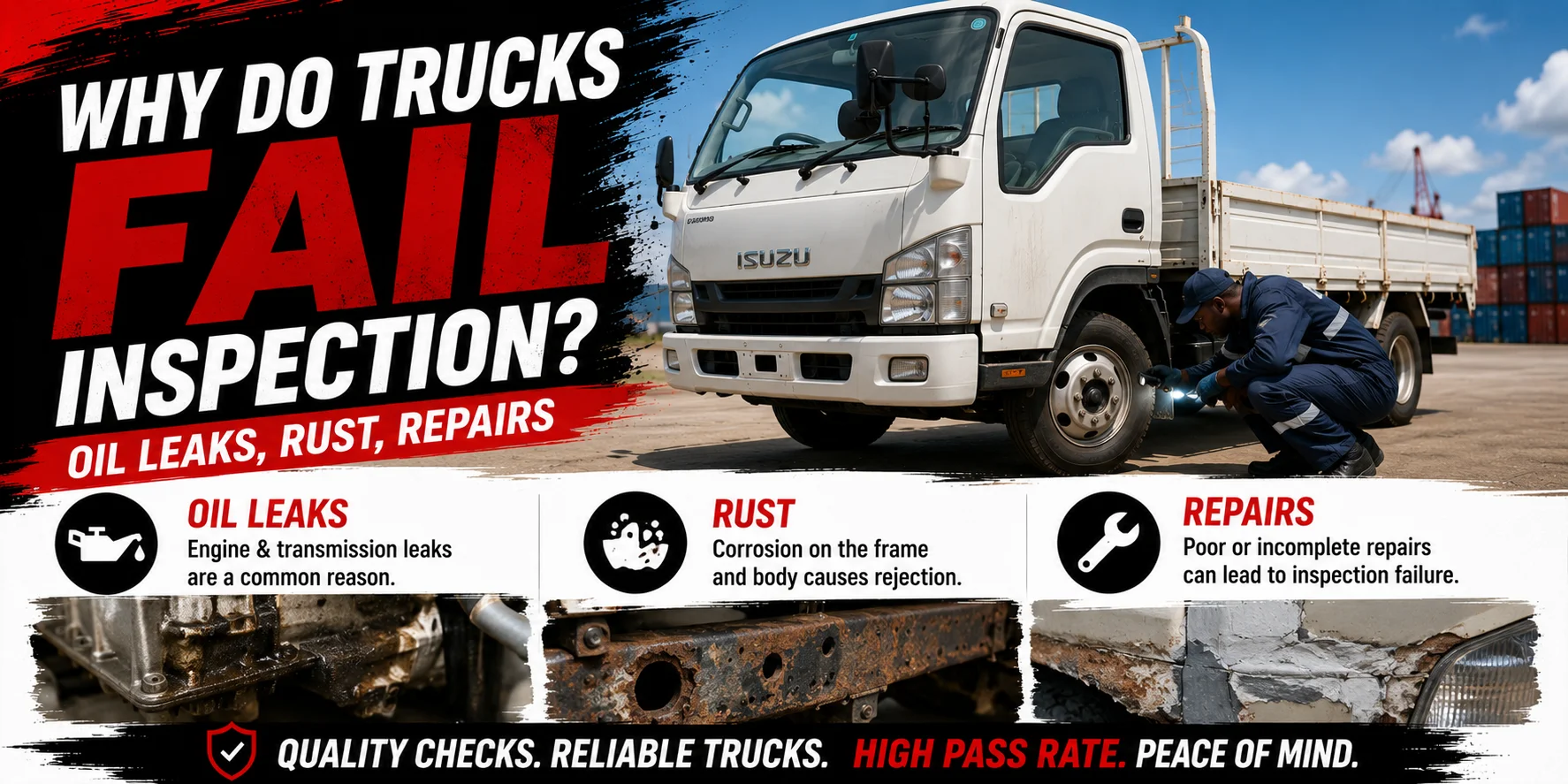
Not every used truck passes inspection on the first attempt. Most failures come from a small number of predictable problems, and many of them can be repaired before shipment. Knowing what inspectors look for helps buyers judge a truck's real condition instead of relying on photos alone.
Why Inspection Matters
An inspection confirms whether a truck is safe and mechanically sound before it is sold or exported.
It also protects the buyer, because problems found in Japan are far cheaper to fix than problems discovered after the truck has arrived overseas.
Failure Reason 1: Oil Leaks
Oil leaks are the most common reason a truck is rejected.
Leaks are usually found around:
- Engine gaskets and the oil pan
- Transmission and rear axle seals
- Power steering lines
- Hydraulic cylinders on tippers and cranes
Most leaks are caused by hardened gaskets, worn oil seals, or loose fittings after many years of use.
How it is repaired: the area is cleaned, the failed gasket or seal is replaced, fittings are re-tightened, and the truck is run again to confirm that the leak has stopped.
Small leaks are usually inexpensive to fix. A leak from inside the engine or transmission is more serious, because the unit must be opened.
Failure Reason 2: Rust and Corrosion
Rust is the second major cause of failure, especially on trucks used in snowy regions where road salt is applied in winter.
Inspectors pay close attention to:
- Chassis rails and crossmembers
- Suspension and spring mounts
- Cab floor and door bottoms
- Deck supports and body brackets
It is important to separate two types of rust.
Surface rust affects only the paint and outer metal. It is treated by removing the rust, applying anti-corrosion treatment, and repainting.
Structural rust reaches through the metal and weakens the frame. Repair requires cutting out the damaged section and welding in new plate, which is far more expensive and is not always worth doing.
This is why buyers should always ask for chassis photos, as explained in our guide on common mistakes when buying used trucks for Tanzania.
Failure Reason 3: Brakes and Suspension
Braking performance is checked carefully because it directly affects safety.
Common problems include:
- Worn brake linings or discs
- Air leaks in the brake system
- Broken or sagging leaf springs
- Weak shock absorbers
How it is repaired: worn friction parts are replaced, air lines and valves are resealed, and broken spring leaves are exchanged. These are standard repairs that most workshops handle routinely.
Failure Reason 4: Engine and Exhaust Condition
A truck may also fail because of how the engine runs.
Typical warning signs are:
- Excessive white or black smoke
- Difficult starting
- Abnormal noise or vibration
- Overheating
How it is repaired: injectors and the fuel pump are serviced or replaced, the cooling system is cleaned, and worn components are renewed. Simple mechanical diesel engines are generally easier and cheaper to repair than electronically controlled engines.
Failure Reason 5: Lights and Electrical Faults
Smaller electrical issues cause a surprising number of failures.
These include broken lamps, faulty wiring, dead batteries, and warning lights that stay on.
How it is repaired: bulbs, fuses, and damaged wiring are replaced, and terminals are cleaned. These repairs are quick and low-cost, but they must be done properly, since a lamp that fails at sea is discovered only after arrival.
How Repairs Are Handled Before Shipment
At WeCarJapan, more than 95% of inspected trucks pass inspection standards.
When a problem is found, we identify whether it is a minor repair or a structural issue, and share that information with the buyer before shipment.
This way, buyers know what they are purchasing instead of discovering faults at the destination port.
Conclusion
Most inspection failures come from oil leaks, rust, brakes, engine condition, and electrical faults.
Many of these are normal for a used truck and can be repaired at reasonable cost.
The important point is to know which problems are minor and which affect the structure of the vehicle, because that difference decides whether a truck is a good buy or an expensive one.