

Why Popular Trucks Differ Between Dar es Salaam and Rural Areas
How Roads, Distance, and Business Type Shape Truck Demand
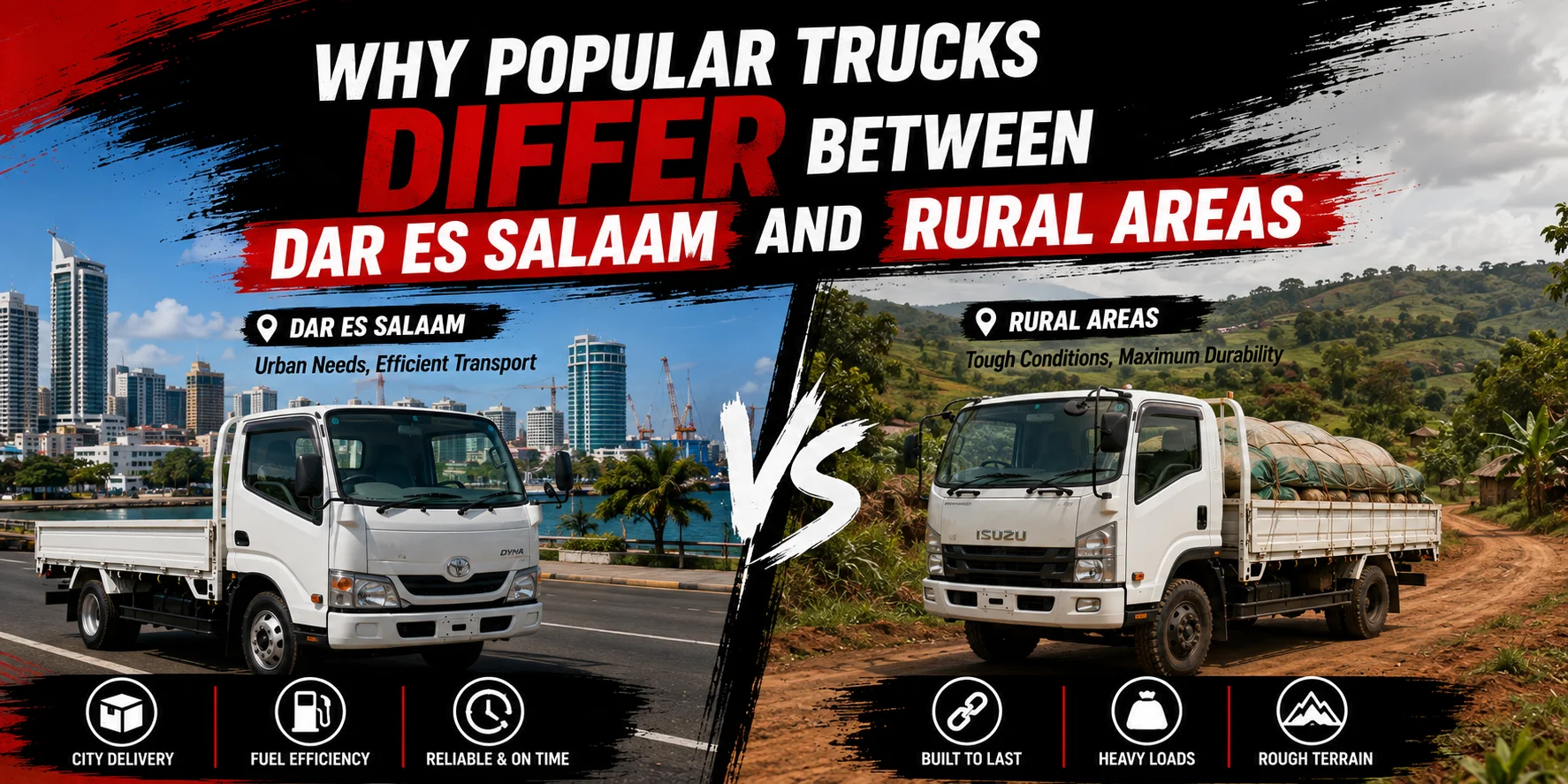
Tanzania is one country, but it is not one market. A truck that works perfectly in Dar es Salaam may be the wrong choice for an operator in Mbeya, Dodoma, or Kigoma. Understanding the difference helps buyers choose a truck that will actually earn money after arrival.
Two Very Different Operating Environments
The main differences come down to:
- Road surface and condition
- Distance travelled per trip
- Type of cargo
- Access to workshops and spare parts
Each of these pushes buyers toward a different kind of truck.
Dar es Salaam: Short Trips, Narrow Streets, Heavy Traffic
Dar es Salaam is the commercial and port centre of the country.
Most transport work here involves:
- Moving goods from the port to warehouses
- Distribution to shops and markets
- Construction material delivery inside the city
- Frequent short trips rather than long hauls
In this environment, manoeuvrability matters more than maximum payload.
Smaller and mid-size trucks such as the Mitsubishi Canter and Isuzu Elf are popular because they can turn in narrow streets, park in tight loading areas, and handle stop-and-go traffic without excessive fuel consumption.
Box bodies and closed bodies are also more common in the city, where cargo needs protection from rain and theft.
Regional and Rural Areas: Long Distance, Rough Roads
Outside the main cities, the priorities change completely.
Operators there deal with:
- Long distances between towns
- Unpaved and eroded roads
- Seasonal mud and river crossings
- Fewer workshops along the route
This favours larger and tougher trucks, typically 4-ton class models such as the Fuso Fighter, Isuzu Forward, and Hino Ranger.
High-deck trucks are also preferred, because extra ground clearance reduces the risk of damage on rough surfaces.
Cargo Type Changes the Body Choice
City operators often carry packaged goods, beverages, and building materials in relatively small quantities.
Rural operators are more likely to carry:
- Agricultural produce such as maize, rice, and cashew
- Timber and building materials
- Livestock
- Fuel and water
This is one reason flatbed trucks remain the most flexible choice upcountry, since the body can be adapted or extended locally.
Repairability Matters More Outside the City
In Dar es Salaam, a truck with a modern electronic engine can usually find a workshop able to diagnose it.
Several hundred kilometres away, that is not guaranteed.
For this reason, rural operators strongly prefer older mechanical diesel engines that can be repaired with basic tools at the roadside.
What This Means When Buying from Japan
Before choosing a truck, think about where it will actually operate.
Useful questions include:
- Will it work mainly inside the city or on long routes?
- What percentage of the route is unpaved?
- Who will repair it, and what parts can they get?
- Will the body be used as it is, or rebuilt locally?
Answering these first makes the model choice much easier.
Conclusion
There is no single "best truck for Tanzania".
Dar es Salaam rewards compact, easy-to-handle trucks, while regional routes reward strength, ground clearance, and simple mechanics.
Choosing based on the actual operating area is one of the most reliable ways to avoid an expensive mistake.