


How to Import a Used Truck from Japan to Tanzania
A Step-by-Step Guide from Quotation to Dar es Salaam Port
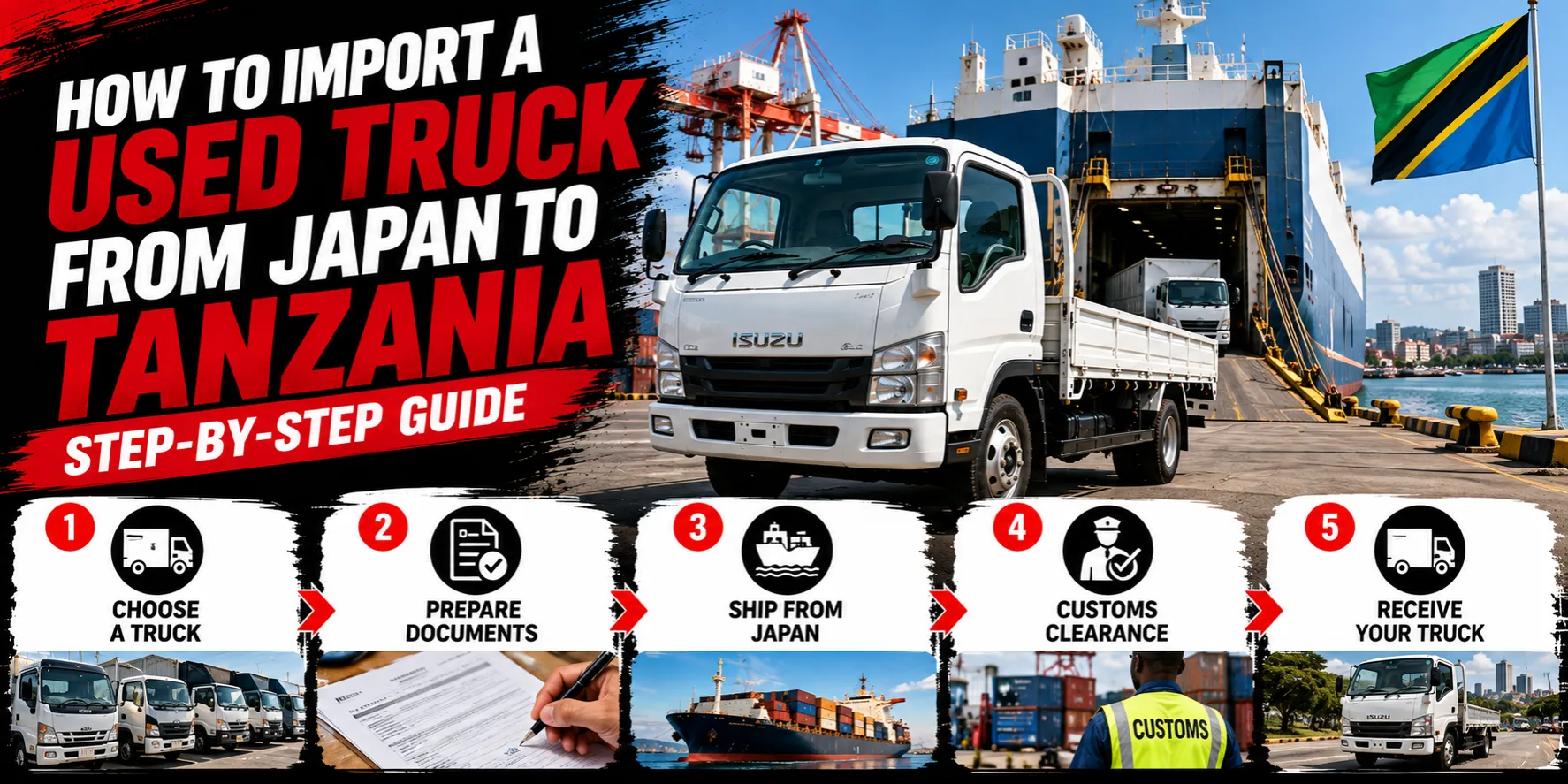
Importing a used truck from Japan is not complicated once you understand the order of each step. This guide explains the full process, from choosing a truck in Japan to collecting it at Dar es Salaam Port.
Step 1: Choose Your Truck
Start by deciding the body type, size, and model that suit your business. In Tanzania, flatbed trucks and the Mitsubishi Canter are the most common choices, while 4-ton class trucks are the mainstream size for general cargo.
When you find a truck in our stock, send us an inquiry by WhatsApp or e-mail with the stock number.
Step 2: Receive a C&F Quotation
We will send you a quotation with the C&F price to Dar es Salaam Port. The C&F price includes:
- Vehicle price
- Ocean freight from Japan to Dar es Salaam
Marine insurance is not included. For used vehicles, insurance only pays out when the vehicle is a total loss, which in practice means only if the ship sinks.
Import duties, taxes, and port clearance in Tanzania are not included in the C&F price either. If you are not sure about the difference between price terms, see What Is C&F Price? The Difference Between C&F, CIF, and FOB.
Step 3: Check the Total Landed Cost
Before you confirm the purchase, estimate the total cost including duties and clearance in Tanzania. Truck age matters: older trucks may be charged additional duty, so the cheapest truck is not always the cheapest to import.
For a reference example, see How Much Does It Cost to Import a Canter? A Reference Example.
Step 4: Proforma Invoice and Payment
When you agree with the quotation, we issue a Proforma Invoice (P/I) and Purchase Agreement (P/A). The truck is held for you for up to 48 hours from the time we issue them.
Payment is 100% of the C&F amount by Telegraphic Transfer (T/T) within 2 business days. Your bank's transfer charge is not included in the C&F price, so please add it when you send the payment. After paying, send us a copy of the T/T transfer slip.
Step 5: Confirm Consignee and Notify Party
After we confirm your payment, we ask for the details needed for the Bill of Lading (B/L):
- Consignee: the owner-to-be of the truck in Tanzania
- Notify Party: the person contacted when the ship arrives (often your clearing agent, or "Same as Consignee")
- Address for receiving the original documents by DHL
Please provide the full name, full address, and phone number for each. Even a small spelling mistake in the consignee name can require a B/L amendment, which costs extra time and fees.
Step 6: Pre-Shipment Inspection and Shipping
Used vehicles exported to Tanzania must pass a pre-shipment inspection in Japan before loading. We arrange the inspection and then book the truck on a vessel to Dar es Salaam.
Shipping from Japan to East Africa usually takes about 3 to 5 weeks. Vessel names and schedules can change for reasons decided by the shipping company, so we will keep you updated on the latest schedule.
Step 7: Receive the Shipping Documents
The shipping company issues the B/L about 10 to 12 days after the vessel departs. We first send you a PDF copy. Please check it carefully, because the B/L may not be amendable after the originals are sent.
After your confirmation, we send the original documents by DHL and share the tracking number. The documents normally include:
- Bill of Lading (B/L)
- Export Certificate
- Commercial Invoice
- Inspection Certificate
Step 8: Customs Clearance in Tanzania
When the vessel arrives, your clearing agent lodges the import declaration with the Tanzania Revenue Authority (TRA) using the original documents. Import duty, taxes, and port charges are paid at this stage, and the truck is released from the port once clearance is complete.
We recommend choosing a reliable clearing agent before the vessel arrives, so the truck does not wait at the port and incur storage charges.
Step 9: Registration and Delivery
After clearance, the truck is registered with TRA and receives Tanzanian number plates. Inland transport from the port to your city is arranged by you or your local logistics partner.
Conclusion
Importing a used truck from Japan to Tanzania follows a clear sequence: choose, quote, pay, ship, clear, and register. Most delays come from incorrect consignee details or late preparation for customs clearance, so check each step before moving to the next.
Our staff will guide you through every step. Please check our stock or contact us for a C&F quotation to Dar es Salaam.